

Author’s Take
After years of working around VA claims, here’s my honest read: veterans pour their energy into the rating percentage and treat the effective date as fine print. That’s backwards math. A 10% rating bump might be worth a couple hundred dollars a month going forward — a corrected effective date can be worth a five-figure check covering months the VA already owed you. The OIG’s finding that roughly a quarter of first-year PACT Act claims carried wrong dates didn’t surprise me at all, because the inputs that prove the error are sitting in veterans’ own files: an Intent to File confirmation, a separation date, an original claim number. Nobody at the VA is going to cross-check those for you after the decision goes out. So my standing advice is simple. File an Intent to File the moment a claim crosses your mind — it costs nothing and only ever helps. And when any decision arrives, check the effective date before you check anything else. If the date is wrong, the one-year clock for the easy fixes is already running.
Quick Answer
Your VA effective date is generally the date the VA received your claim or the date entitlement arose, whichever is later, under 38 CFR § 3.400 — and it controls every dollar of your back pay. The VA pays a lump sum covering each month between your effective date and your first regular payment. The date on your decision letter isn’t always right: a VA Office of Inspector General review estimated about 24% of first-year PACT Act claims were assigned incorrect effective dates. If yours is wrong, you can challenge it through a Higher-Level Review, a Board appeal, or a CUE claim.

How the VA Picks Your Effective Date (and Why It’s Worth Real Money)
When the VA grants your claim, it doesn’t start paying you from the day of the decision. It looks backward to your effective date and cuts you a lump-sum check covering every month in between. That’s your back pay, and the effective date is the single number that determines how big it is. The general rule lives in 38 CFR § 3.400: your effective date is the date the VA received your claim or the date entitlement arose, whichever is later. For most veterans who file years after leaving service, that means the day the VA received the claim — the condition has usually existed far longer than the claim has been pending. Here’s why the date matters so much in dollars. The 2026 rate for a 70% rating with no dependents is $1,808.45 per month, per the VA’s official rate tables. If your claim takes nine months to decide, the effective date entitles you to roughly $16,276 in back pay before your first regular monthly payment ever arrives. Move that date three months earlier or later and you’ve swung the check by more than $5,400. The VA assigns the date; your job is to verify it. Every rule in this article exists because the default date isn’t always the most favorable date the law allows.
The One-Year Discharge Rule: File Within a Year, Get Paid From Day One
There’s one exception every recently separated veteran should know. Under 38 CFR § 3.400(b)(2), if the VA receives your original claim within one year of your separation from active duty, your effective date is the day after your discharge — not the day you filed. Consider what that means in practice. A veteran separates on June 15, 2025, and files a claim on March 1, 2026, just inside the one-year window. The VA grants 70% in November 2026. The effective date isn’t March 2026; it’s June 16, 2025. That’s roughly eight extra months of compensation, over $14,000 at the 70% single-veteran rate, simply because the claim landed inside the window. The flip side is just as important: file thirteen months after separation instead of eleven, and the rule disappears entirely. Your effective date snaps forward to your filing date, and the months between discharge and filing are gone for good. If you’re within a year of separation right now and haven’t filed, this is the most valuable deadline on your calendar. And if you already filed within that year but your decision letter shows a filing-date effective date instead of the day after discharge, the VA miscalculated — that’s a correctable error, not a judgment call.

Intent to File: Lock In Your Date Before Your Claim Is Ready
Most veterans aren’t ready to file the day they decide to pursue a claim. Records take months to gather, exams take time to schedule, and the effective date quietly slips later with every week of delay. The Intent to File process, set out in 38 CFR § 3.155, solves this. You notify the VA that you plan to file — online through VA.gov, by phone, or by mailing VA Form 21-0966 — and that notice locks in your potential effective date immediately. You then have one full year to submit the complete claim. File within that year, and the VA uses your Intent to File date as the effective date. An Intent to File submitted in June with a formal claim filed the following December means six extra months of back pay you’d otherwise have surrendered, at zero cost and with no evidence required up front. Two warnings. First, the one-year deadline is unforgiving: miss it, and the protected date evaporates — the VA uses your actual filing date instead. Second, the date that counts is the date recorded in the VA’s system, not the date you mailed a form. Confirm your Intent to File appears in your VA.gov account or in a written acknowledgment. If it’s not in the system, it doesn’t protect anything.
How VA Back Pay Is Actually Calculated
Back pay isn’t a flat multiplication. The VA calculates it month by month, applying the compensation rate that was in effect for each month between your effective date and your first ongoing payment, at the rating and dependent status you held during that period. Walk through an example using official VA rates. Say your effective date is August 1, 2025, the VA grants 70% with no dependents in April 2026, and your first regular payment starts in May 2026. You’re owed nine months. The months from August through November 2025 pay at the 2025 rate ($1,759.19), and the months from December 2025 onward pay at the 2026 rate ($1,808.45), because the 2.8% cost-of-living adjustment took effect December 1, 2025. Total: roughly $16,079, paid as a single lump sum, typically by direct deposit within about 15 days of the decision — though longer waits happen. Three things veterans often get wrong about that check. It’s tax-free; VA disability compensation, including retroactive payments, is exempt from federal income tax under 38 U.S.C. § 5301, and you won’t receive a 1099 for it. It can be reduced by offsets, like prior VA overpayments or military separation pay the VA is required to recoup. And it should reflect your dependents — if you had a spouse or children during the back-pay period and the rating is 30% or higher, the lump sum should be computed at the with-dependents rate for those months.

The VA Assigns the Wrong Date More Often Than You’d Think
If this article convinces you of one thing, let it be this: read the effective date on your decision letter with suspicion. In April 2025, the VA Office of Inspector General published a review of PACT Act-related claims completed in the law’s first year and estimated that about 31,400 of 131,000 claims — roughly 24 percent — were assigned incorrect effective dates, producing at least $6.8 million in improper payments. The OIG also flagged about 2,300 additional claims where processors decided cases before gathering enough evidence to establish the most advantageous date, and projected improper payments could reach $20.4 million over the law’s first three years if the patterns continued. The causes the OIG identified weren’t exotic: inadequate processor training, unreliable automated date-calculation tools, and premature decisions. None of those failure modes are unique to PACT Act claims. In practice, the same handful of errors shows up again and again across all claim types: an Intent to File date that was never honored, a supplemental claim assigned its own filing date instead of relating back to the original claim, and the one-year discharge rule miscalculated or skipped. Each one is checkable from documents you already have. Pull your decision letter, find the effective date, and compare it against your Intent to File confirmation, your original claim date, and your separation date. If the VA used a later date than the rules allow, every month in the gap is money you’re owed.
Earlier-Date Exceptions Most Veterans Miss
Beyond the basics, federal regulations contain several paths to an effective date earlier than your filing date — and the VA won’t always volunteer them. For increased-rating claims, 38 CFR § 3.400(o)(2) allows the effective date to reach back up to one year before you filed, if it’s factually ascertainable from medical records or credible lay statements that your service-connected condition worsened during that year. A veteran who files for an increased PTSD rating in March, with treatment notes showing the deterioration started the previous July, can be paid from July. For previously denied claims, 38 CFR § 3.156(c) is the heavyweight: if the VA later grants your claim based on relevant official service records that existed but weren’t in the file at the time of the original denial, the effective date resets to the date of that original claim. That can mean years — sometimes decades — of retroactive compensation. And when a new law or VA regulation creates entitlement, such as a new presumptive condition, 38 CFR § 3.114 permits payment up to one year before your application, though never earlier than the law’s own effective date. None of these apply automatically in every case, and the evidence requirements are specific. But if your situation fits one of them and your decision letter ignores it, you have grounds to ask for the earlier date and the back pay that comes with it.
How to Challenge a Wrong Effective Date
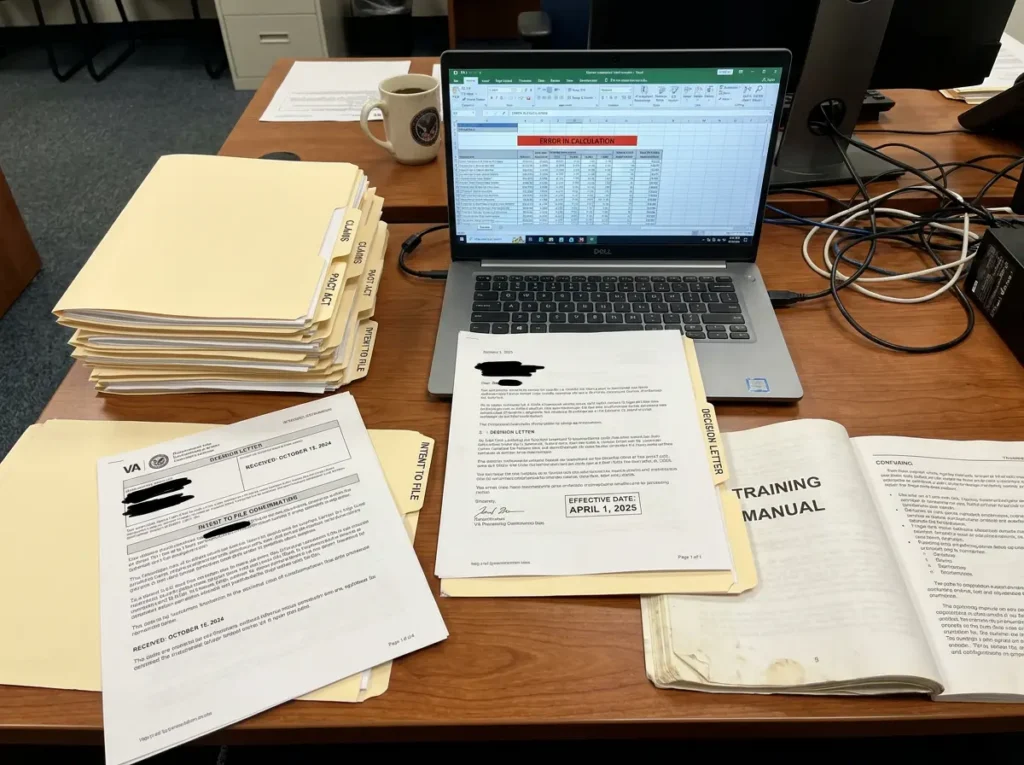
You have three main lanes, and which one fits depends on where your claim stands. If the decision is less than a year old, a Higher-Level Review (VA Form 20-0996) asks a more senior adjudicator to re-examine the same record for error — well suited to clear mistakes like an ignored Intent to File date, since no new evidence is allowed. A Supplemental Claim (VA Form 20-0995) lets you add new and relevant evidence, like treatment records showing your condition worsened earlier; filed within one year of the decision, it preserves continuous pursuit of your original date. Appealing to the Board of Veterans’ Appeals puts the question in front of a Veterans Law Judge, which makes sense for genuine legal disputes about which rule applies. If the decision is already final — meaning the appeal window closed years ago — your remaining path is a motion to revise based on Clear and Unmistakable Error (CUE). CUE is a demanding standard: you must show an undebatable error that, if corrected, would have changed the outcome. But when it succeeds, the effective date is fixed as of the original decision, and the back pay runs from there. One discipline matters across all three lanes: act inside the one-year window whenever you can. Effective-date challenges get harder, not easier, with time, and the difference between a routine correction and a CUE fight is usually just the calendar.
Example Scenario
Marcus, 48, left the Army in June 2019 with worsening knee problems and what he’d later learn was PTSD. He didn’t file anything until February 2024 — but that January, while still tracking down treatment records, he submitted an Intent to File through VA.gov. His formal claim went in eleven months later, in December 2024, and the VA granted 70% in September 2025. Because his complete claim arrived inside the twelve-month window, his effective date was January 2024, not December — eleven additional months that turned his lump sum from about $15,800 into roughly $35,000. When his decision letter initially listed the December date, his representative pointed to the Intent to File confirmation in his VA.gov account, and the date was corrected. The lesson Marcus passes along: the Intent to File took him ten minutes, and it was worth more than any other ten minutes of the entire claim.

The Effective Date Rules that Apply to You
| Your situation | Your effective date | Governing rule |
| Original claim filed more than 1 year after discharge | Date the VA received the claim (or date entitlement arose, if later) | 38 CFR § 3.400 |
| Original claim filed within 1 year of separation | Day after discharge | 38 CFR § 3.400(b)(2) |
| Intent to File submitted, formal claim filed within 12 months | Date the VA received the Intent to File | 38 CFR § 3.155 |
| Increased rating, worsening shown within the year before filing | Date the increase became factually ascertainable, up to 1 year before the claim | 38 CFR § 3.400(o)(2) |
| Grant based on newly found official service records | Date of the original claim — potentially years earlier | 38 CFR § 3.156(c) |
| Award under a new law or presumptive condition | Up to 1 year before application, no earlier than the law’s effective date | 38 CFR § 3.114 |