

Author’s Take
If I could get every veteran to change one habit, it would be this: stop reading the decision letter for the verdict and start reading it for the reasoning. Almost everyone flips to the percentage, feels whatever they feel, and files the rest in a drawer. But the percentage is the conclusion — the leverage is in how the VA got there. The Reasons for Decision section tells you precisely which element fell short, the Evidence list tells you what the VA never looked at, and the diagnostic code tells you whether your symptoms were measured against the right yardstick. None of that requires a law degree to check; it requires twenty unhurried minutes and a willingness to compare the letter against your own paperwork. The veterans who win appeals aren’t usually the ones with new conditions — they’re the ones who read the existing decision carefully enough to see where it went wrong. And the clock starts the day that letter is dated, so the read you do this week is worth more than the read you do next month.
Quick Answer
Your VA rating decision letter is organized into four main sections — an Introduction, a Decision, an Evidence list, and a Reasons for Decision section — usually arriving with a Notice of Action cover letter. The Decision section holds the dollars: each claimed condition marked granted or denied, plus the percentage and effective date for grants. The Reasons for Decision section holds the appeal leverage: it explains exactly why the VA ruled the way it did and cites the regulations behind each call. Read it section by section, find your diagnostic code, and compare your symptoms to the rating criteria — that’s how you spot whether the VA made a mistake.

What the Letter Is and Where to Find It
A VA rating decision letter is the VA’s official written ruling on your disability compensation claim — what it granted, what it denied, and the reasoning behind each call. It usually arrives as a package. The first document is typically a Notice of Action, a short cover letter that summarizes the outcome and explains your appeal rights; the second is the rating decision itself, on Veterans Benefits Administration letterhead, which lays out the detail. You don’t have to wait for the mail. The fastest way to get the letter is to download it from your VA.gov account under your claim’s documents, where it’s posted at the same time the paper copy goes out. Here’s the mindset to bring before you read a single line: this is not a verdict to absorb and file away. It’s a blueprint of how the VA evaluated your claim, and every section is checkable against what you actually submitted. The veterans who recover money they’re owed are the ones who read it like an auditor — looking for what the VA got wrong, what it overlooked, and what it quietly conceded. The rest of this guide walks each section in the order it appears, and tells you exactly what to verify in each one.
The Introduction: Small Errors, Big Consequences
The introduction reads like boilerplate — your name, VA file number, branch and dates of service, the type of claim, and the date the VA received it. It’s tempting to skip. Don’t. This section sets the factual frame the entire decision is built on, and a small error here can cost you real money. The date the VA lists as your claim or Intent to File date drives your effective date, which drives your back pay. Wrong deployment dates can affect presumptive exposure eligibility. An omitted prior claim can erase an earlier effective date you were entitled to. Read every fact in the introduction against your own records: your DD-214, your claim confirmation, your Intent to File acknowledgment in VA.gov. If the VA’s version of your timeline is off, flag it now — because the rest of the letter inherits that error, and correcting it later is harder than catching it on day one. This is the cheapest section to verify and one of the most consequential to get right.
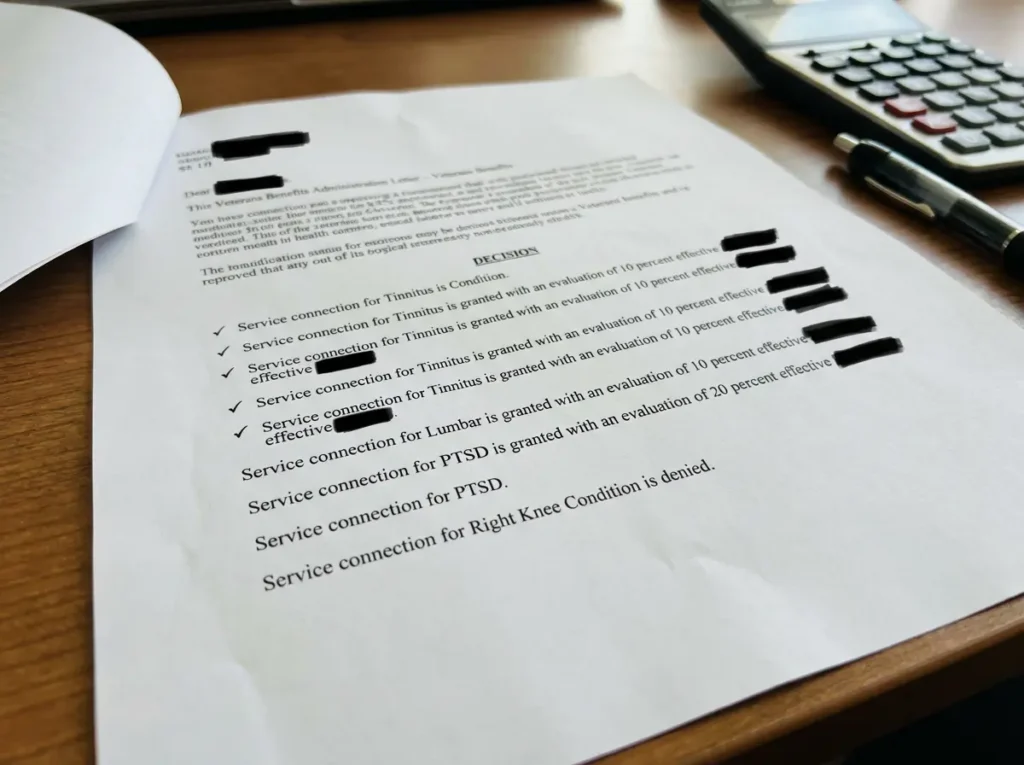
The Decision: Where the Dollars Are Set
The Decision section is the part most veterans turn to first, and rightly so — it controls the money. It lists every condition you claimed and marks each one granted or denied. For each granted condition, you’ll find two numbers that matter enormously: the disability rating percentage and the effective date. The percentage determines your monthly compensation; the effective date determines how far back your retroactive pay reaches. Read this section as a banker would. Confirm that every condition you actually claimed appears here — a claimed condition that’s simply missing is a processing error, not a denial, and it’s correctable. Check each effective date against your filing timeline. And if you have multiple conditions, note that the VA combines them using its own math rather than adding them, so a 50% and a 30% condition don’t make 80%. This section may also list special benefits if they apply, such as Special Monthly Compensation for loss or loss of use of a limb, or Total Disability based on Individual Unemployability (TDIU) if you can no longer work because of service-connected conditions. If you expected one of those and don’t see it addressed, that’s worth a closer look.
The Evidence List: Read It Like a Receipt
The Evidence section is a plain list of everything the VA says it considered: service treatment records, VA and private medical records, exam results (often a C&P exam), buddy statements, and anything else in your file. Veterans skim this section because it looks administrative. That’s a mistake — it’s one of the most powerful error-catching tools in the whole letter. Treat it like a receipt and check it against what you know you submitted. If you sent in a private nexus letter from your doctor and it’s not on this list, the VA may have decided your claim without ever weighing your strongest piece of evidence. If updated treatment records showing your condition worsened aren’t listed, the rating may have been set against a stale, thinner record than the one that actually exists. A missing or ignored piece of evidence is frequently the cleanest basis for a Higher-Level Review, because you’re not arguing the VA was wrong about the facts — you’re showing it didn’t have all of them. Make a side-by-side list: what you submitted, and what the VA acknowledged. The gaps are your leverage.

Reasons for Decision: The Most Important Section You’ll Read
This is the longest section, the one most veterans find most intimidating, and the one that decides your next move. Reasons for Decision explains, issue by issue, why the VA ruled the way it did, and it cites the specific regulations behind each call. Read it as a checklist of legal elements, because that’s what it is. For most service-connection claims, the VA is deciding whether you proved three things: a current diagnosis, an in-service event, injury, or exposure, and a nexus — a medical link connecting the two. When a claim is denied, this section tells you which of the three the VA found missing, and that diagnosis points straight at the fix. If the VA conceded your in-service event and your diagnosis but said the nexus was weak, your appeal needs a stronger medical opinion, not more service records. When service connection is granted but the percentage is lower than you expected, the fight shifts from whether you’re connected to how severe the VA found your condition — measured against the rating criteria for your diagnostic code. One more thing to hunt for here: favorable findings. Under the modern appeals system, any fact the VA decides in your favor is listed and is binding on every future VA adjudicator unless there’s clear evidence to the contrary. That means the VA’s own concessions become locked-in building blocks for your appeal. Read this section slowly, twice, with a highlighter.
Decode Your Diagnostic Code (This Is Where Low Ratings Hide)
Next to each rated condition, the VA prints a four-digit diagnostic code. It’s easy to overlook, but it’s the single most useful number for checking whether your rating is too low. Each diagnostic code maps your condition to a specific set of rating criteria in 38 CFR Part 4, the VA’s Schedule for Rating Disabilities, and those criteria spell out exactly which symptoms and limitations earn each percentage. Here’s the self-check, and it costs nothing. Find your diagnostic code on the decision. Go to eCFR.gov (the free, official regulations site) and search that code or condition. Read the criteria for the percentage you received and the criteria for the next level up. Then compare them honestly against your documented symptoms. If your medical records describe symptoms that match the higher level, you have a factual basis to challenge the rating. Watch for analogous codes, written as two codes joined by a hyphen like ‘DC 8730-8520’ — the VA used a similar condition’s criteria because yours isn’t separately listed, and the wrong analogy can quietly undervalue you. Also keep the benefit-of-the-doubt rule in mind: when the evidence for two rating levels is roughly balanced, the law requires the VA to assign the higher one. That rule is routinely overlooked on initial decisions, which is exactly why reading your own criteria pays off.

If You Disagree: Your Options and the Deadlines That Actually Apply
If the decision is dated on or after February 19, 2019, you have three review lanes under the Appeals Modernization Act, and you can pick a different lane for each issue. A Supplemental Claim (VA Form 20-0995) adds new and relevant evidence — the right lane when the Evidence section revealed something missing, like that nexus letter. A Higher-Level Review (VA Form 20-0996) asks a senior adjudicator to re-examine the same record for error, with no new evidence — ideal when you believe the VA misapplied the criteria or used the wrong diagnostic code. A Board appeal (VA Form 10182) puts the issue before a Veterans Law Judge. Now the deadline, because there’s a widespread myth worth correcting. For most initial decisions, you have one full year from the date on your decision letter to file in any of the three lanes — not 60 days. The 60-day figure that circulates online comes from narrower situations: a contested claim, or opting into the modern system from an older Statement of the Case. For a standard rating decision, the number to protect is one year. That said, the practical advice is the same as the urgent advice: don’t wait. The longer you sit, the more likely supporting evidence goes stale and the closer you drift to the deadline that, once missed, makes the decision final and far harder to reopen.

Example Scenario
Diego, 39, opened his decision letter and went straight to the number: 30% for his knee, denial on his back. He almost stopped there. Instead he worked the letter section by section. The Evidence list didn’t mention the private MRI report he’d uploaded for his back — a clue that the strongest document in his file may never have been weighed. In Reasons for Decision, the VA had actually conceded his in-service fall and his current back diagnosis, then denied on nexus alone; that concession was a favorable finding, binding going forward. And when he looked up his knee’s diagnostic code on eCFR.gov, the criteria for the next level up described his exact range-of-motion limits, already documented in his C&P exam. He filed a Supplemental Claim on the back, pointing to the overlooked MRI, and a Higher-Level Review on the knee rating. The letter hadn’t just told him no — read closely, it had handed him the map for what to do next.
Quick Guide to Deciphering your Rating Decision
| Section of the letter | What it tells you | What to verify |
| Introduction | Service dates, claim type, date claim received | Service dates and claim/effective date match your records |
| Decision | Each condition granted or denied; percentage and effective date for grants | Every claimed condition appears; percentages and dates are right |
| Evidence | Everything the VA says it considered | Each item you submitted is listed — flag anything missing |
| Reasons for Decision | Issue-by-issue rationale and cited regulations | Which of the 3 elements failed; favorable findings noted |
| Diagnostic code | Maps each condition to 38 CFR Part 4 criteria | Your symptoms vs. the criteria for the next level up |